


BookLab
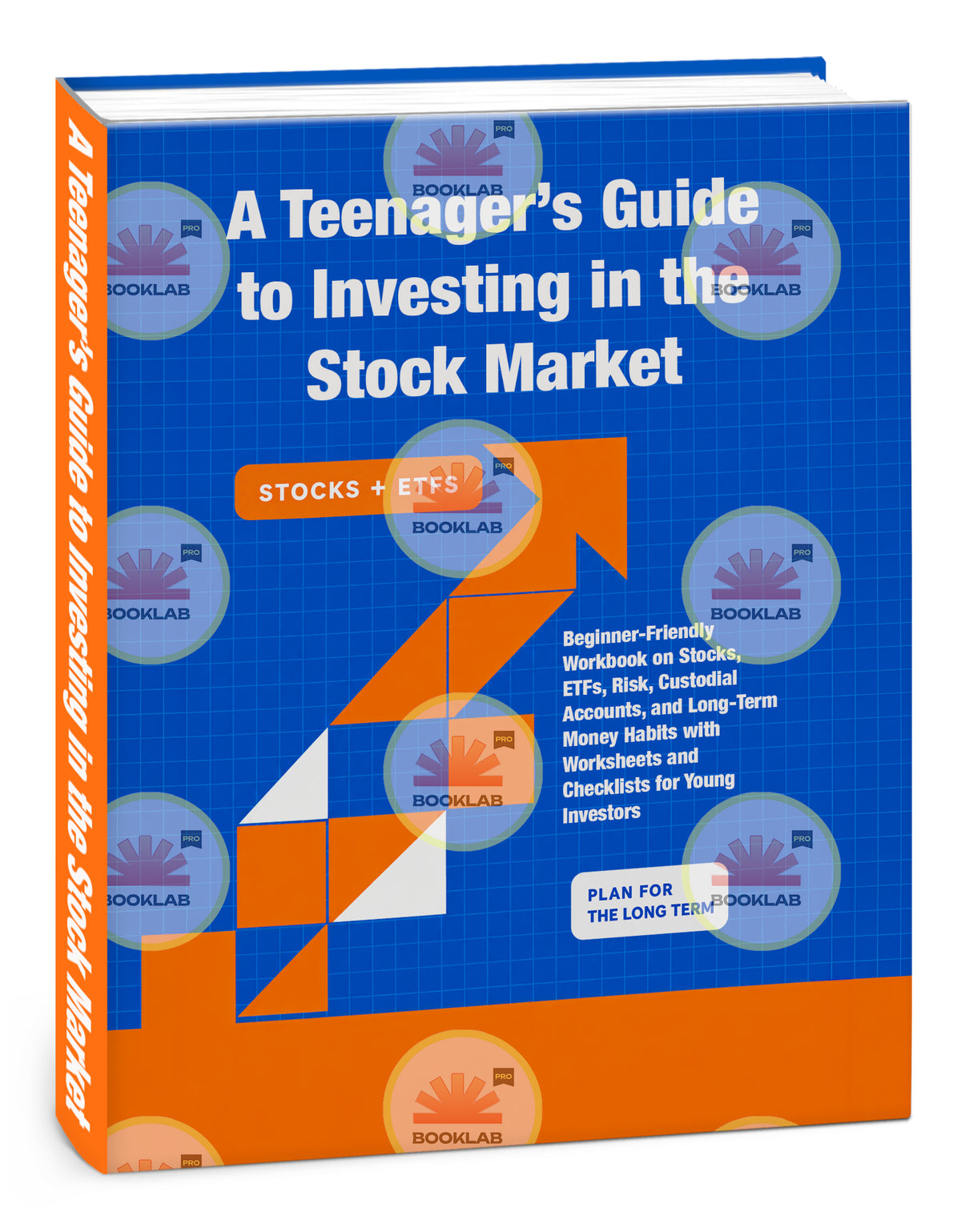
A Teenager’s Guide to Investing in the Stock Market
A Teenager’s Guide to Investing in the Stock Market
SKU:17678225
- Ready to publish on Amazon KDP
- Human-Written Manuscript
Couldn't load pickup availability
Premium Publishing Asset for Amazon Sellers: A Teenager’s Guide to Investing in the Stock Market
A complete, professionally structured 80-page financial education manuscript featuring beginner-friendly stock market explanations, investing fundamentals, risk management principles, custodial account guidance, long-term planning strategies, interactive worksheets, and practical checklists — fully written, organized, and ready for publishing preparation.
This publishing asset is designed for Amazon sellers entering or expanding within the teen financial literacy, beginner stock market investing, personal finance education, money management, and educational workbook niches.
Created for teenagers, young investors, parents, and educators, the manuscript combines accessible financial concepts with structured exercises that encourage informed decision-making, responsible investing habits, and long-term financial awareness.
⭐️ What’s Included
✔️ Complete 80-page manuscript focused on stock market education for teenagers
✔️ 14 structured chapters covering financial foundations, investment types, risk, and long-term planning
✔️ Beginner-friendly explanations of stocks, stock exchanges, share ownership, and market price movements
✔️ Educational comparisons of stocks, bonds, ETFs, and mutual funds
✔️ Guidance on compound growth, inflation, budgeting, emergency savings, and financial goal setting
✔️ Dedicated chapter explaining investment risk, volatility, diversification, and time horizons
✔️ Risk tolerance questionnaire for evaluating comfort with market fluctuations
✔️ General guidance on custodial investment accounts, including US UTMA and UGMA structures
✔️ Introductory information about investment accounts for minors in the UK and European Union
✔️ Practical criteria for comparing brokerage platforms, account fees, regulation, and reliability
✔️ Step-by-step framework for developing an individual investment plan
✔️ Explanations of dollar-cost averaging, investment timelines, and long-term financial habits
✔️ Introduction to company research, stock quotes, and dividends
✔️ Educational discussions of emotional investing, FOMO, panic selling, and speculative trading risks
✔️ Guidance on investment fees, taxes, and responsible financial decision-making
✔️ 13 chapter-based worksheets reinforcing key financial concepts
✔️ 13 corresponding checklists for reviewing knowledge and financial readiness
✔️ Quick-reference comparisons, financial terminology, and a dedicated glossary
✔️ Guidance encouraging parent or guardian involvement in investment decisions
✔️ Suitable for Kindle and paperback publishing preparation
📈 Why This Is a Valuable Publishing Asset
You’re getting a professionally organized 80-page financial literacy manuscript — not a short introduction to stock market terminology or a collection of generic investment tips.
The teen investing niche connects several reader interests, including financial education for teenagers, stock market fundamentals, beginner investing, money management, family financial planning, and long-term wealth-building concepts.
Parents and educators often look for accessible resources that explain investing without unnecessary complexity or unrealistic promises of financial success.
This manuscript provides a progressive educational framework that begins with personal money management and introduces investment concepts, risk awareness, account structures, and long-term planning.
Its 13 worksheets and 13 checklists transform the material into an interactive learning experience, helping readers apply financial concepts to their own goals and circumstances.
The inclusion of custodial account guidance and parent-focused activities also makes the manuscript relevant to families exploring responsible investment education.
💼 Ideal For
- KDP publishers expanding their financial literacy and personal finance catalogs
- Publishing agencies seeking structured educational nonfiction manuscripts
- Entrepreneurs developing Kindle, paperback, or digital financial products
- Sellers entering the teen investing and stock market beginner niches
- Publishers targeting teenagers, parents, educators, and first-time investors
- Amazon sellers exploring interactive finance workbooks and youth money-management resources
🚀 What Makes This Book Special
- Written specifically for teenagers and young investors
- Accessible financial explanations combined with practical activities
- 14 progressively structured chapters
- 13 worksheets and 13 chapter-based checklists
- Coverage of stocks, ETFs, bonds, mutual funds, and diversification
- Custodial account guidance and emphasis on parental involvement
- Risk-management principles and common beginner mistakes
- Brokerage comparison and introductory company-research techniques
- Budgeting, financial goal setting, and long-term planning
- No specific investment recommendations
- No guaranteed returns or get-rich-quick messaging
- Strong foundation for a focused financial literacy publication
This is a complete publishing asset for Amazon sellers seeking a practical, education-focused manuscript in the teen financial literacy, beginner investing, and stock market education niches.
With its 80-page structure, 14 chapters, investing fundamentals, custodial account guidance, risk-management explanations, 13 worksheets, 13 checklists, and long-term planning resources, A Teenager’s Guide to Investing in the Stock Market provides a strong foundation for developing a professional Amazon KDP publication focused on responsible financial education for young readers.
- Number of pages: 80
- Trim Size Paperback: 8,5*11
- Trim Size Hardcover: 8,25*11
Share
What's Included
-
Manuscript PDF
Complete manuscript in PDF format
-
eBook Format
Ready-to-publish electronic book format
-
Plagiarism Report
Detailed plagiarism check report
-
Book Cover
Covers that sell and visuals that grab attention
-
Book Description
Book description for marketing purposes
-
Book Quality Guide
Guide to reviewing book quality before publishing on Amazon KDP
Book Details
Human-Written Content
This manuscript was written by human authors and reviewed by editors. We do not use AI-generated text for the core book content. Each title is created as an original publishing asset for Amazon KDP sellers who want ready-to-use, professional-quality content.
Outline Overview
Table of Contents
Introduction: How to Use This Book
- Understanding the educational purpose of the guide
- Using the chapters, worksheets, and checklists
- Involving a parent or guardian
- Setting realistic expectations about investing
- Important legal and financial disclaimers
Part I: Money Foundations
Chapter 1: Why Teenagers Should Learn About Investing
- Why starting early creates a powerful advantage
- Understanding compound growth
- Beginning with small amounts of money
- Connecting investing to personal goals
- Developing a responsible money mindset
- Worksheet: Why I Want to Learn About Investing
- Checklist: Investor Mindset Check
Chapter 2: Money Basics Before the Market
- Understanding income, spending, and saving
- Creating a simple personal budget
- Building an emergency fund before investing
- How inflation affects the value of cash
- Deciding how much money may be available to invest
- Worksheet: My Monthly Money Map
- Checklist: Am I Financially Ready to Invest?
Part II: Understanding the Stock Market
Chapter 3: How the Stock Market Works
- What it means to own shares in a company
- Why companies sell stock
- Understanding stock exchanges
- How buyers and sellers affect prices
- Why stock prices rise and fall
- Worksheet: Match the Investing Terms
- Checklist: Essential Stock Market Vocabulary
Chapter 4: Stocks, Bonds, ETFs, and Mutual Funds
- Stocks as company ownership
- Bonds as a form of lending
- How ETFs combine multiple investments
- How mutual funds work
- Comparing costs, diversification, and accessibility
- Choosing investment types based on personal goals
- Worksheet: Which Investment Type Fits Me?
- Checklist: Before Choosing an Investment
Chapter 5: Understanding Investment Risk
- The relationship between risk and potential return
- What market volatility means
- Why diversification matters
- Matching investments to a time horizon
- Understanding personal risk tolerance
- Recognizing investments that may be too risky
- Worksheet: Risk Tolerance Questionnaire
- Checklist: Investment Risk Red Flags
Part III: How to Start Investing
Chapter 6: Investing as a Minor
- Why teenagers usually need adult involvement
- Understanding custodial brokerage accounts
- UTMA and UGMA accounts in the United States
- General account considerations in the UK and European Union
- What happens when the teenager reaches legal adulthood
- Questions to discuss with a parent or guardian
- Worksheet: Family Investing Discussion
- Checklist: Information Needed to Open an Account
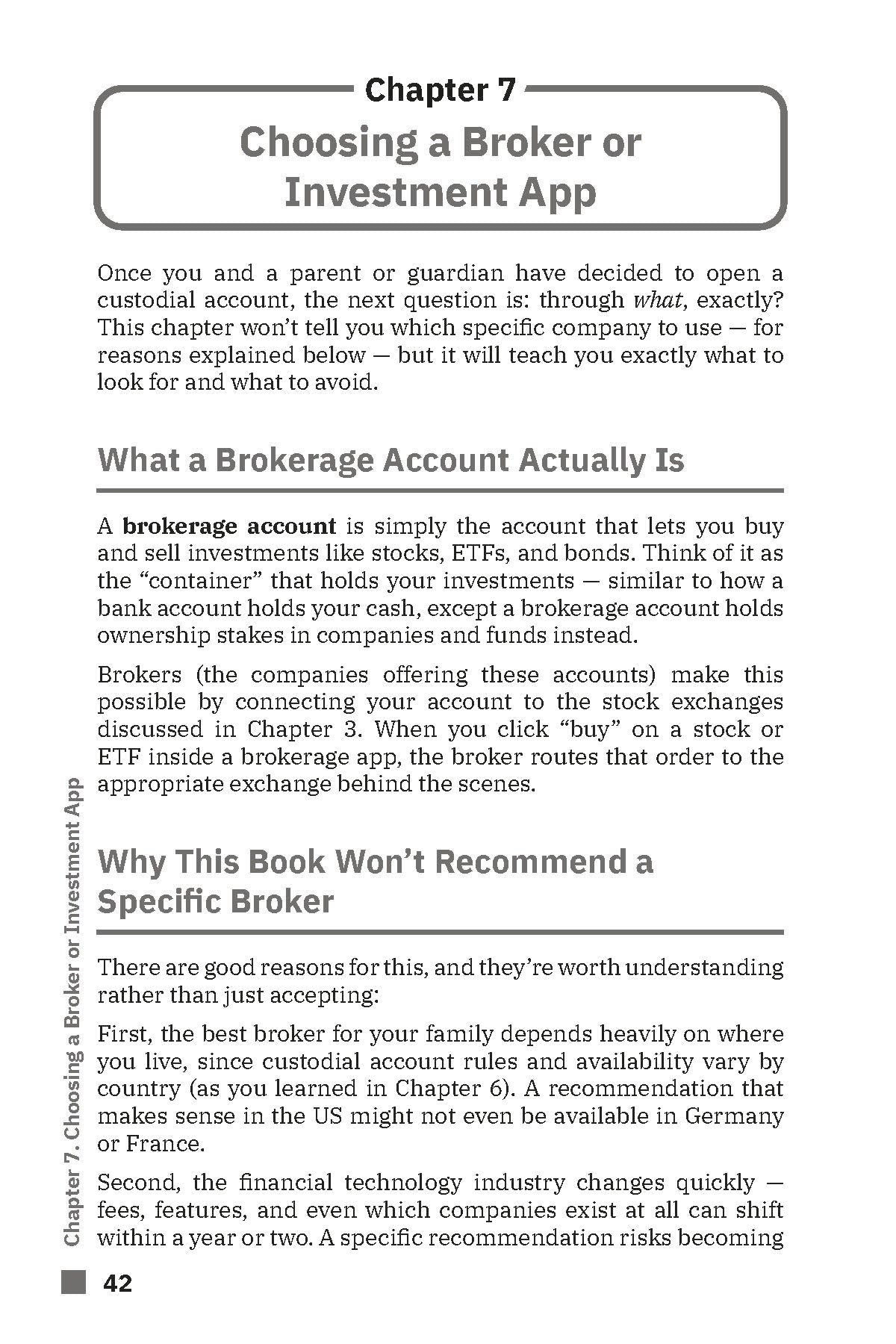
Chapter 7: Choosing a Broker or Investment App
- Understanding the role of a brokerage account
- Comparing account fees and investment options
- Checking regulation, security, and reliability
- Evaluating educational tools and customer support
- Identifying questionable platforms and warning signs
- Worksheet: Broker Comparison Chart
- Checklist: Is This Brokerage Platform Trustworthy?
Chapter 8: Creating a First Investment Plan
- Defining a clear financial goal
- Selecting an appropriate investment timeline
- Reviewing personal risk tolerance
- Understanding dollar-cost averaging
- Exploring a simple starter approach
- Writing down personal investing rules
- Worksheet: My Investment Goal Sheet
- Checklist: Before Making an Investment
Part IV: Thinking Like an Investor
Chapter 9: Researching Companies and Investments
- Understanding ticker symbols
- Reading a basic stock quote
- Learning how dividends work
- Finding reliable company information
- Separating trustworthy research from online hype
- Developing a research-before-buying habit
- Worksheet: Research a Company
- Checklist: Reliable Source or Marketing Hype?
Chapter 10: Emotions and Common Investing Mistakes
- Understanding fear and greed
- Avoiding panic selling during market declines
- Recognizing FOMO and social-media pressure
- The risks of chasing trends
- Why margin, leverage, and day trading can be dangerous
- Creating a plan for difficult market periods
- Worksheet: What Will I Do If the Market Falls?
- Checklist: Beginner Mistakes to Avoid
Chapter 11: The Power of Long-Term Thinking
- How compound growth develops over time
- Understanding historical market behavior
- Reinvesting dividends and investment gains
- Building consistent habits instead of chasing quick profits
- Connecting investments to five- and ten-year goals
- Worksheet: My Long-Term Financial Vision
- Checklist: Long-Term Investor Mindset
Part V: Building Responsible Financial Habits
Chapter 12: Taxes, Fees, and the Fine Print
- How investment fees affect long-term results
- Understanding basic investment taxes
- Recognizing the possible costs behind “free” trading
- Reading account terms and disclosures
- Asking questions before committing real money
- Worksheet: Investment Fee Tracker
- Checklist: Questions to Ask Before Investing
Chapter 13: Building Smart Habits for Life
- Creating a regular saving and investing routine
- Using automatic contributions responsibly
- Deciding how often to review investments
- Continuing financial education carefully
- Updating goals as circumstances change
- Connecting investing with budgeting and future planning
- Worksheet: Personal Investing Habit Tracker
- Checklist: Annual Investor Review
Chapter 14: Glossary and Quick Reference
- Essential stock market terminology
- Stocks, bonds, ETFs, and mutual funds comparison
- Risk and diversification reminders
- Basic brokerage and account terminology
- US custodial account overview
- General UK and EU account considerations
- Quick-reference investor checklist
Conclusion: Your Investing Journey Starts Now
- Reviewing the most important lessons
- Starting carefully and responsibly
- Staying patient during market changes
- Continuing to learn over time
- Making financial decisions based on goals and values
- A final note for parents and guardians
Sample Chapter
Chapter 1
Why Should a Teenager Care About Investing?
Here’s a question worth sitting with for a second: if you had $1,000 right now, what would you do with it?
Most people picture spending it. Maybe new shoes, a phone upgrade, concert tickets, or saving for a car. None of that is wrong — money is meant to be used. But there’s a third option most teenagers never get shown: what if that $1,000 could quietly grow into something much bigger, just by sitting in the right place for a long time, doing almost nothing?
That’s the entire idea behind this book. Not get-rich-quick schemes. Not stock-picking magic. Just one simple, slightly unfair advantage that you have right now and will never have again: time.
The One Advantage Money Can’t Buy
Imagine two people. We’ll call them Maya and Jordan.
Maya starts investing $100 a month starting at age 16. Jordan does the exact same thing — $100 a month, the same investments, the same returns — but doesn’t start until age 26, ten years later. Both stop adding new money once they turn 40 and just let it sit until they retire at 65.
Who ends up with more money?
It’s not close. Maya wins by a wide margin — not because she invested more money overall (in fact, she invests more total cash than Jordan, simply because she has more years of contributions), and not because she picked better investments. She wins because her money had ten extra years to grow on top of itself. That’s compound growth, and it’s the closest thing to magic that exists in personal finance.
Even though Maya contributes for more years than Jordan (24 years of contributions versus Jordan’s 14), Maya’s money has ten extra years to compound — to earn returns on top of returns — before either of them retires. That ten-year head start, started as a teenager, can make a meaningfully large difference to the final outcome by retirement, depending entirely on how markets actually perform over those decades — which nobody can know in advance. The exact numbers will vary, and markets are never guaranteed, but the pattern — that early money grows disproportionately more than later money, given the same contributions — holds true no matter what specific numbers you plug in.
This is why financial educators get so excited about teenagers learning this stuff. You’re not behind. You’re not too young. You are, mathematically, in the best possible position to benefit from this idea that most adults wish someone had explained to them at sixteen.
“But I Don’t Need to Be Rich to Start, Right?”
Right. This is one of the biggest myths about investing, and it stops more people from starting than almost anything else.
You do not need $10,000. You do not need a finance degree. You do not need to understand Wall Street jargon. Many brokerages today let you start with $5, $1, or even fractional shares of a single stock. The amount you start with matters far less than the fact that you start — and that you build the habit of adding to it regularly.
Let’s clear up a few more myths while we’re at it, because chances are you’ve absorbed at least one of these without realizing it:
Myth: “Investing is basically gambling.” Gambling is designed so that, on average, the house wins and you lose — that’s how casinos make money. Long-term investing in a diversified set of companies is structurally different: you’re buying small ownership stakes in real businesses that (ideally) grow, hire people, sell products, and generate profits over time. There’s real risk, and you can lose money — this book won’t pretend otherwise — but it’s not the same mathematical trap as a casino game.
Myth: “The stock market is only for adults with serious money.” The stock market doesn’t check your age once a custodial account is set up by a parent or guardian. It also doesn’t care if you’re investing $20 or $20,000 — the principles are identical either way.
Myth: “If I don’t understand everything about the economy, I shouldn’t invest.” You don’t need to predict the economy. You need to understand a handful of core ideas — which is exactly what the rest of this book will give you — and then let time do most of the heavy lifting.
So Why You, Specifically, Right Now?
Because every year you wait is a year of compound growth you don’t get back. Not in a scary, anxiety-inducing way — there’s no need to panic or feel behind — but in a simple, factual way: starting at 16 instead of 26 isn’t a 10-year delay. Mathematically, it can be closer to losing half your potential growth, because so much of the magic of compounding happens in the final stretch, which only exists if you started early enough to have a “final stretch” in the first place.
You’re reading this at the exact moment in your life when this advantage is most available to you. That’s worth pausing on.
Worksheet 1.1 — Why I Want to Learn This
Take a few honest minutes with these. There’s no wrong answer — this is just for you.
- What’s one thing (a goal, a purchase, a feeling of security) that money could help you with in the next 5–10 years?
- Before reading this chapter, what did you believe about investing? Where do you think that belief came from (family, social media, friends, school)?
- Maya started at 16 and ended up far ahead of Jordan, who started at 26. How does it feel to know you’re currently in “Maya’s position” — right at the start?
- If you started investing just $20–50 a month starting today, how old would you be after 10 years? After 20 years?
- What’s one myth about investing (from this chapter or elsewhere) that you’re now ready to let go of?
Checklist — Mindset Check
Before moving to Chapter 2, check in with yourself on each of these:
- [ ] I understand that investing is about long-term growth, not getting rich overnight.
- [ ] I understand that I could lose money, especially in the short term, and that this is a normal part of investing — not a sign I did something wrong.
- [ ] I understand that I don’t need a lot of money to start.
- [ ] I understand that starting early — even with small amounts — gives me a real, mathematical advantage.
- [ ] I’m ready to keep learning before I put any real money into the market.
If you checked all five, you’re ready for Chapter 2. If one or two feel shaky, that’s okay — re-read the relevant section above before moving on. This mindset is the foundation on which everything else in this book is built.
See Inside the Book


