


BookLab
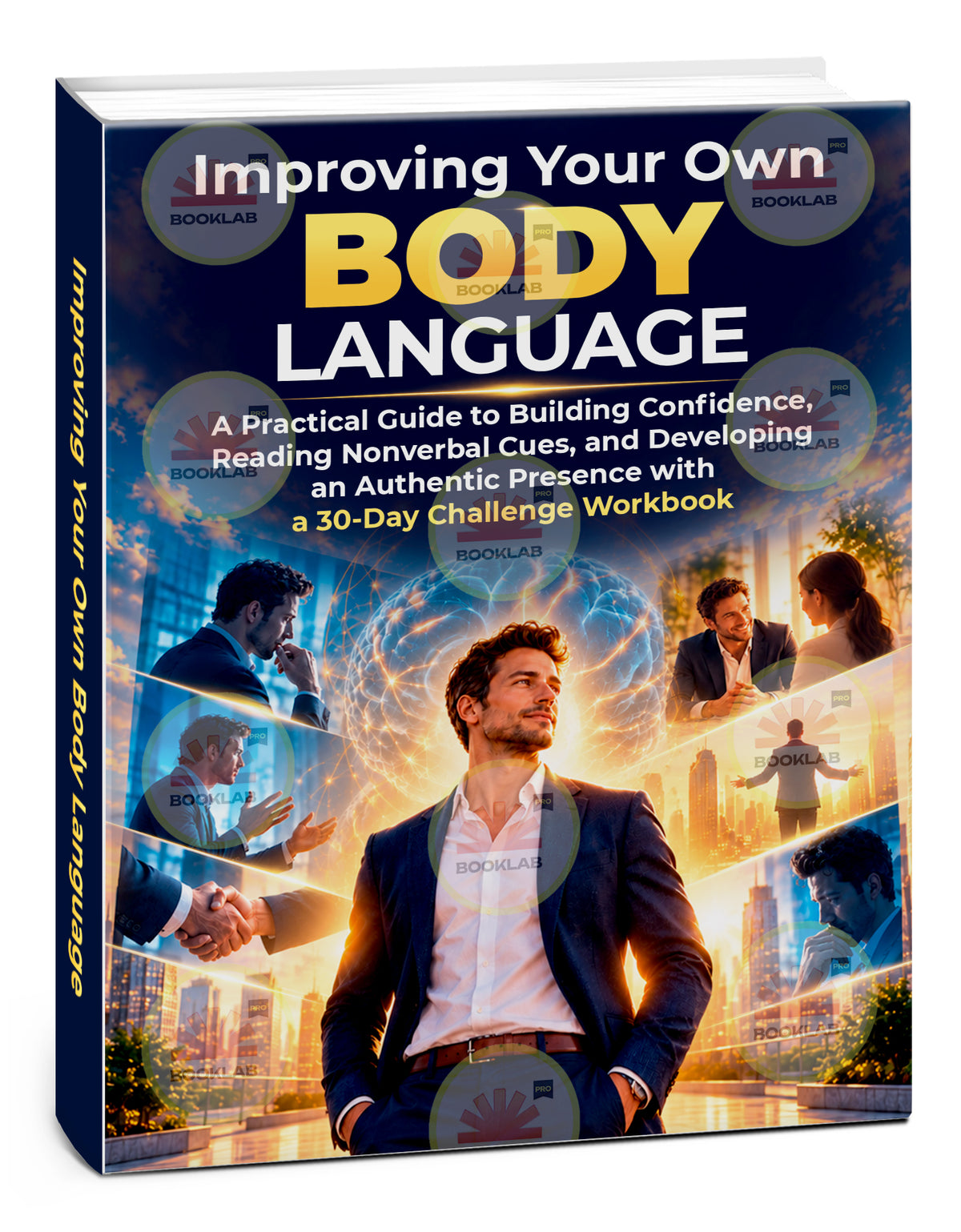
Improving Your Own Body Language
Improving Your Own Body Language
SKU:16070312
- Ready to publish on Amazon KDP
- Human-Written Manuscript
Couldn't load pickup availability
Premium Publishing Asset for Amazon Sellers: Improving Your Own Body Language
A complete, professionally structured 465-page personal development manuscript featuring practical body language techniques, nonverbal communication strategies, confidence-building exercises, real-world applications, and a 30-day challenge workbook — fully written, organized, and ready for publishing preparation.
This publishing asset is designed for Amazon sellers entering or expanding within the body language, communication skills, self-confidence, emotional intelligence, leadership, and personal development niches.
Created for professionals, students, entrepreneurs, and readers seeking stronger interpersonal communication skills, the manuscript combines foundational concepts with practical exercises, self-assessment tools, and structured skill-building activities.
⭐️ What’s Included:
✔️ Complete 465-page manuscript focused on body language, confidence, and authentic communication
✔️ 18 comprehensive chapters organized into six progressive sections
✔️ Foundational guidance on nonverbal communication, first impressions, and personal presence
✔️ Practical techniques covering posture, eye contact, facial expressions, gestures, and movement
✔️ Voice and breathing exercises for developing clearer, more confident communication
✔️ Professional strategies for interviews, presentations, meetings, networking, and negotiations
✔️ Social communication guidance addressing relationships, personal boundaries, and rapport building
✔️ Techniques for interpreting nonverbal cues and understanding communication patterns
✔️ Cultural awareness guidance for international and multicultural interactions
✔️ Digital communication strategies for video calls and remote work
✔️ Advanced exercises involving mirror practice, video analysis, and self-assessment
✔️ Industry-specific applications for leadership, healthcare, education, sales, and other professions
✔️ Adaptable communication techniques for different ages, personalities, and physical needs
✔️ Structured 30-day challenge workbook with exercises and progress-tracking sheets
✔️ Additional 90-day development framework, reference guides, and practical checklists
✔️ Suitable for Kindle and paperback publishing preparation
📈 Why This Is a Valuable Publishing Asset
You’re getting an extensive, professionally organized 465-page manuscript — not a basic collection of communication tips.
The body language niche connects several established reader interests, including confidence-building, interpersonal communication, emotional intelligence, professional development, and social skills.
This manuscript addresses these interests through a structured framework combining theoretical foundations, practical techniques, workplace applications, and guided personal development exercises.
Its comprehensive coverage extends from everyday gestures and facial expressions to professional negotiations, cultural communication, leadership, and digital presence.
The dedicated workbook, self-assessment activities, and long-term practice resources encourage continued reader engagement beyond the main chapters.
💼 Ideal For:
• KDP publishers expanding their communication and self-improvement catalogs
• Publishing agencies seeking comprehensive nonfiction manuscripts
• Entrepreneurs developing Kindle, paperback, or digital educational products
• Sellers entering the body language and confidence-building niches
• Publishers targeting professionals, students, and leadership audiences
• Amazon sellers exploring interactive personal development workbooks
🚀 What Makes This Book Special:
• Combines 18 chapters with practical exercises and structured learning
• Covers professional, social, cultural, and digital communication
• Emphasizes authentic confidence rather than artificial behavior
• Includes a dedicated 30-day challenge workbook
• Features long-term development and progress-tracking resources
• Provides specialized communication techniques for different professions
• Encourages practical skill development without guaranteeing specific outcomes
This is a complete publishing asset designed for Amazon sellers seeking a substantial manuscript in the body language and personal development niches.
With its 465-page structure, comprehensive communication guidance, practical exercises, 30-day challenge workbook, and advanced development resources, Improving Your Own Body Language provides a strong foundation for creating a professional Amazon KDP publication focused on confidence, communication, and authentic personal presence.
- Number of pages: 465
- Trim Size Paperback: 8,5*11
- Trim Size Hardcover: 8,25*11
Share
What's Included
-
Manuscript PDF
Complete manuscript in PDF format
-
eBook Format
Ready-to-publish electronic book format
-
Plagiarism Report
Detailed plagiarism check report
-
Book Cover
Covers that sell and visuals that grab attention
-
Book Description
Book description for marketing purposes
-
Book Quality Guide
Guide to reviewing book quality before publishing on Amazon KDP
Book Details
Human-Written Content
This manuscript was written by human authors and reviewed by editors. We do not use AI-generated text for the core book content. Each title is created as an original publishing asset for Amazon KDP sellers who want ready-to-use, professional-quality content.
Outline Overview
Table of Contents
Introduction: Understanding the Power of Body Language
- How nonverbal communication shapes first impressions
- Recognizing the signals your body already sends
- Understanding the role of body language in confidence and communication
- What this guide can and cannot help readers achieve
- How to use the exercises and assessments
- Preparing for the 30-day practical challenge
Part I: Understanding Your Current Body Language
Chapter 1: The Science of Nonverbal Communication
- The origins and purpose of body language
- How the brain processes nonverbal signals
- The connection between posture, emotions, and behavior
- How first impressions develop
- Understanding body language research without oversimplifying it
- Action Step: Personal Body Language Assessment
Chapter 2: Discovering Your Body Language Patterns
- Using mirror observation to improve self-awareness
- Recording and reviewing natural behavior
- Identifying unconscious gestures and habits
- Recognizing personal stress signals
- Understanding cultural influences on communication
- Action Step: Create a Body Language Baseline Report
Chapter 3: Developing an Authentic Presence
- What makes someone appear confident and approachable
- Understanding the difference between confidence and arrogance
- The foundations of charisma and personal presence
- Managing internal energy and external expression
- Why authenticity matters
- Adapting your presence to professional, social, and personal situations
- Action Step: Design Your Ideal Presence Profile
Part II: Mastering the Essential Elements
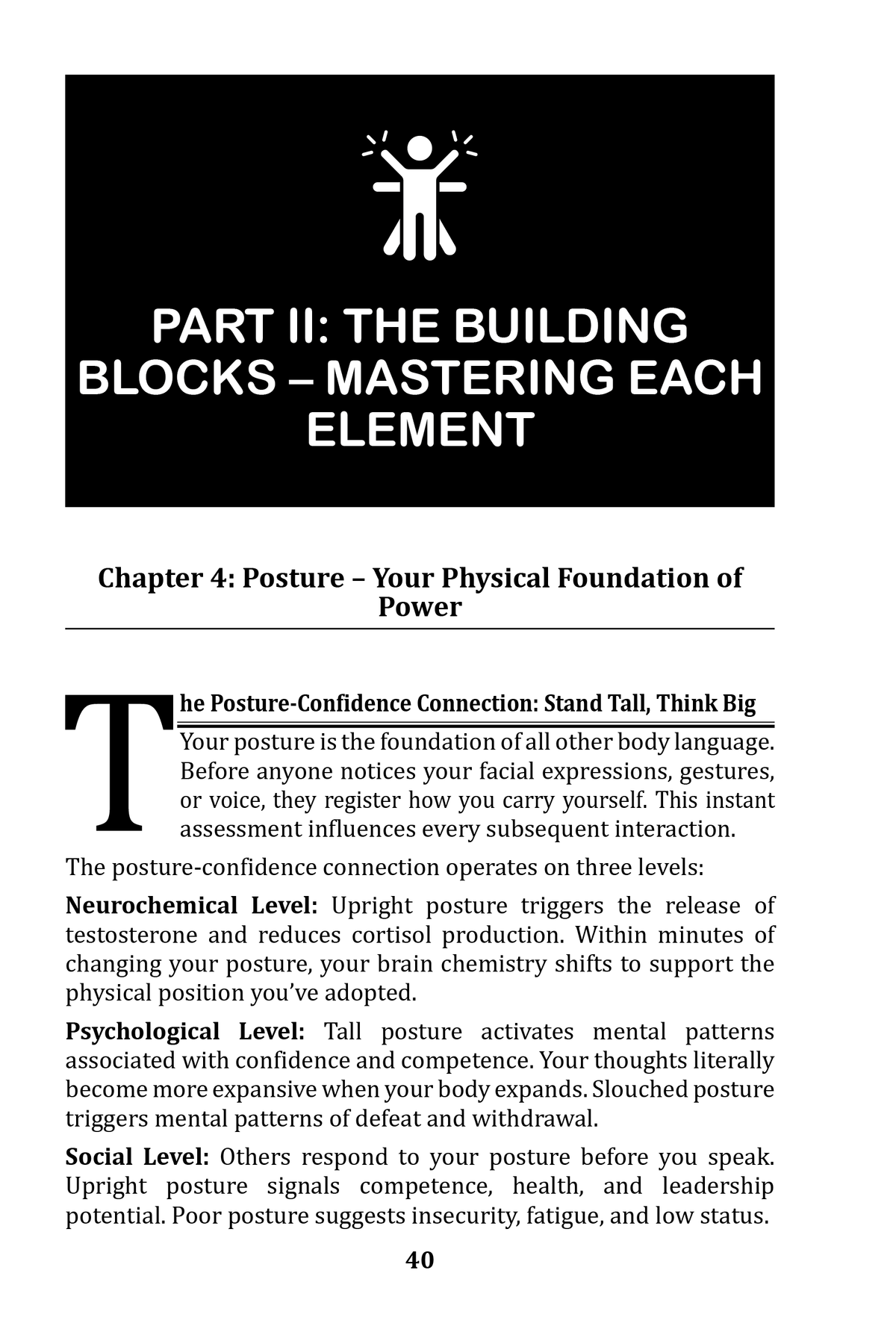
Chapter 4: Posture and Purposeful Movement
- How posture influences confidence and perception
- Correcting slouching and screen-related posture habits
- Building balanced standing and seated posture
- Walking with greater purpose
- Practical posture-correction exercises
- Action Step: 21-Day Posture Challenge
Chapter 5: Facial Expressions and Eye Contact
- Using facial expressions to support communication
- Maintaining comfortable and appropriate eye contact
- Understanding genuine and socially polite smiles
- Recognizing subtle facial signals
- Managing nervous facial habits
- Action Step: Daily Facial Expression Practice
Chapter 6: Hands, Arms, and Meaningful Gestures
- Understanding common hand and arm signals
- Using gestures to reinforce spoken messages
- Choosing natural resting positions
- Reducing closed or defensive body language
- Avoiding culturally inappropriate gestures
- Action Step: Gesture Training Practice
Chapter 7: Voice, Breathing, and Vocal Presence
- Developing a clear and confident speaking voice
- Using breathing to support calm communication
- Managing pace, pitch, and volume
- Using pauses effectively
- Reducing filler words and uncertain speech patterns
- Practical voice-training exercises
- Action Step: Vocal Development Routine
Part III: Applying Body Language in Everyday Life
Chapter 8: Professional Body Language
- Preparing nonverbal communication for job interviews
- Understanding meeting-room dynamics
- Building a confident presentation presence
- Networking with greater ease
- Communicating effectively during video calls
- De-escalating difficult workplace conversations
- Action Step: Professional Presence Makeover Plan
Chapter 9: Social and Relationship Communication
- Reading nonverbal cues in personal relationships
- Strengthening family communication
- Navigating parties and social gatherings
- Using body language during conflict resolution
- Building rapport through appropriate mirroring
- Communicating personal boundaries
- Action Step: Social Confidence Challenge
Chapter 10: High-Pressure Situations
- Managing visible signs of anxiety
- Using nonverbal communication during negotiations
- Developing confidence in public speaking
- Communicating calmly during stressful situations
- Preparing for interviews, first dates, and important meetings
- Recovering from awkward communication moments
- Action Step: High-Pressure Simulation Training
Part IV: Advanced Communication Skills
Chapter 11: Reading and Adapting to Others
- Observing nonverbal communication patterns
- Avoiding unreliable assumptions about truth and deception
- Adapting communication to different personalities
- Understanding ethical nonverbal influence
- Building emotional intelligence
- Creating more cooperative interactions
- Action Step: Reading and Adaptation Practice
Chapter 12: Cultural Intelligence
- Universal and culture-specific communication signals
- Avoiding nonverbal mistakes in international settings
- Adapting to multicultural workplaces
- Understanding gender-related communication without stereotypes
- Communicating across generations
- Respecting religious and social contexts
- Action Step: Cultural Communication Toolkit
Chapter 13: Body Language in the Digital Age
- Looking confident and engaged on video calls
- Improving posture, framing, and eye-line on camera
- Understanding nonverbal presentation in photos and videos
- Reducing screen-related posture problems
- Maintaining face-to-face communication skills
- Preparing for changing communication technologies
- Action Step: Digital Presence Review
Part V: Creating Long-Term Change
Chapter 14: The 90-Day Development Plan
- Phase One: Awareness and foundational habits
- Phase Two: Skill development and regular practice
- Phase Three: Integration into real-life situations
- Creating effective daily routines
- Completing weekly skill-building challenges
- Measuring progress and maintaining motivation
- Action Step: Launch Your 90-Day Plan
Chapter 15: Advanced Practice Techniques
- Using mirror practice effectively
- Reviewing recordings as a self-coaching tool
- Practicing with a partner
- Knowing when professional coaching may be useful
- Developing body awareness through mindfulness
- Supporting presence through physical conditioning
- Action Step: Create an Advanced Training Routine
Chapter 16: Troubleshooting Common Challenges
- Managing self-consciousness and overthinking
- Responding constructively to setbacks
- Adapting exercises to physical needs
- Maintaining progress during stressful periods
- Handling criticism and feedback
- Replacing perfectionism with consistent improvement
- Action Step: Build a Personal Support System
Part VI: Specialized Applications
Chapter 17: Body Language Across Professions
- Sales and customer service
- Healthcare and patient communication
- Education and classroom presence
- Legal and client-facing environments
- Entertainment and media
- Leadership and management
- Action Step: Customize Techniques for Your Profession
Chapter 18: Adapting Communication to Individual Needs
- Confident communication for introverts
- Adaptive techniques for physical limitations
- Body language considerations for older adults
- Confidence-building for teens and young adults
- Communication in cross-cultural relationships
- Emotional well-being and nonverbal behavior
- Action Step: Create Your Personalized Approach
Conclusion: Maintaining an Authentic Presence
- Reviewing personal progress
- Understanding how improved communication affects others
- Maintaining skills through regular practice
- Supporting others without becoming overly analytical
- Exploring advanced areas of communication
- Creating a long-term commitment to authentic growth
Additional Materials
- Quick-reference body language guide
- Two-minute confidence preparation routine
- Cultural communication reminders
- Profession-specific checklists
- Common communication problems and practical responses
30-Day Challenge Workbook
- Daily observation and practice exercises
- Posture, eye contact, gesture, and voice activities
- Progress-tracking sheets
- Weekly assessments and adjustments
- Troubleshooting prompts
- Completion review and next-step planning
Resources for Continued Development
- Recommended books, videos, and educational materials
- Professional development opportunities
- Communities and practice groups
- Helpful apps and self-assessment tools
- Guidance for evaluating coaches and trainers
Sample Chapter
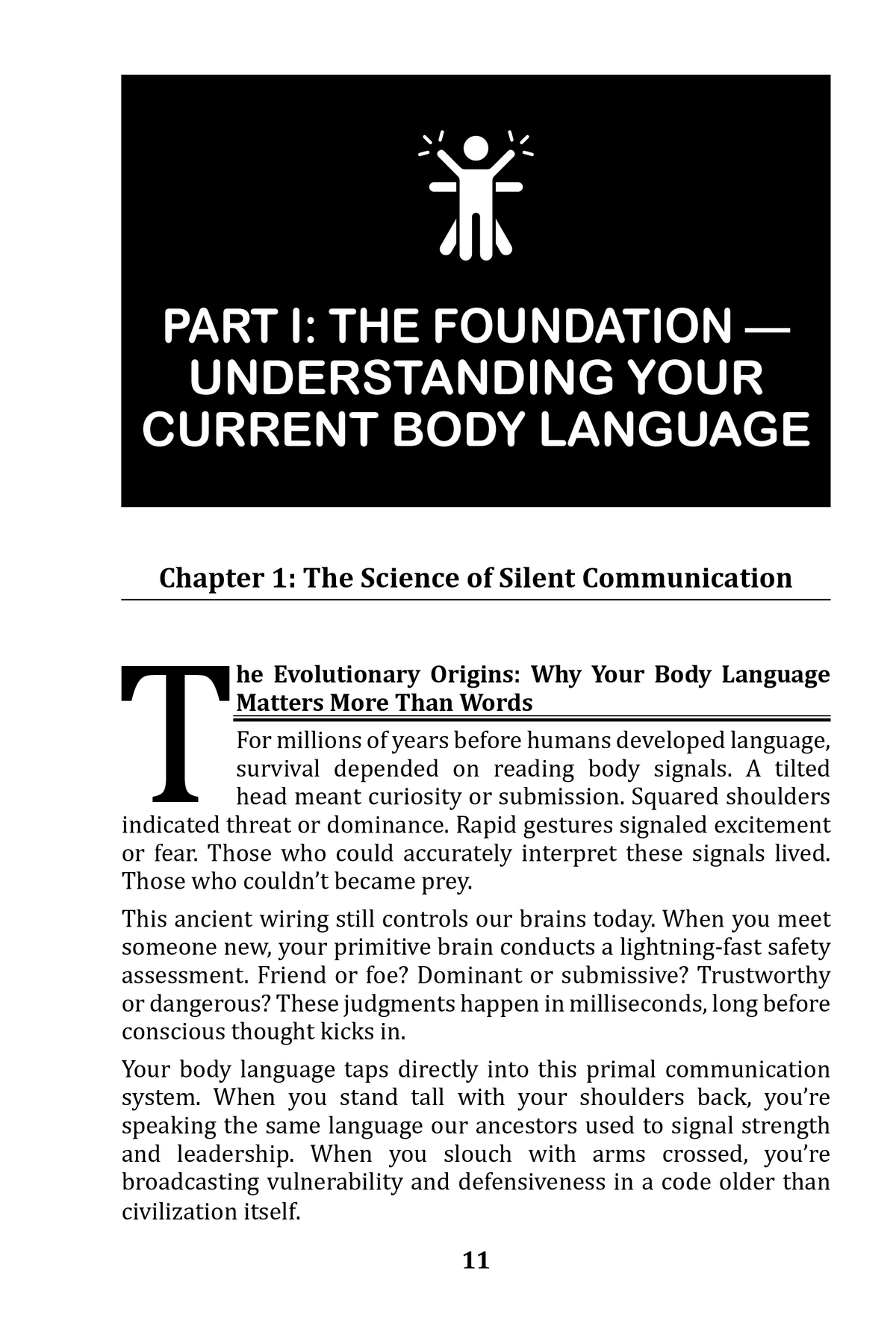
Chapter 1: The Science of Silent Communication
The Evolutionary Origins: Why Your Body Language Matters More Than Words
For millions of years before humans developed language, survival depended on reading body signals. A tilted head meant curiosity or submission. Squared shoulders indicated threat or dominance. Rapid gestures signaled excitement or fear. Those who could accurately interpret these signals lived. Those who couldn't became prey.
This ancient wiring still controls our brains today. When you meet someone new, your primitive brain conducts a lightning-fast safety assessment. Friend or foe? Dominant or submissive? Trustworthy or dangerous? These judgments happen in milliseconds, long before conscious thought kicks in.
Your body language taps directly into this primal communication system. When you stand tall with your shoulders back, you're speaking the same language our ancestors used to signal strength and leadership. When you slouch with arms crossed, you're broadcasting vulnerability and defensiveness in a code older than civilization itself.
This is why body language feels so powerful and immediate. It's not just communication—it's survival programming that bypasses rational thought and speaks directly to the emotional brain.
Your Brain on Body Language: The Neuroscience of Nonverbal Communication
Modern neuroscience reveals exactly how body language works in the brain. Mirror neurons fire both when you perform an action and when you observe someone else performing that same action. If you see someone cross their arms defensively, your mirror neurons fire as if you're crossing your arms, creating an instant empathetic response.
The visual cortex processes body language faster than the language centers process words. Facial expressions are decoded in as little as 17 milliseconds. Posture and gesture recognition happens in under 100 milliseconds. Meanwhile, processing spoken words takes 600 milliseconds or more.
This speed difference explains why first impressions feel so immediate and decisive. Your brain has already made crucial decisions about someone based on their body language before they finish their first sentence.
The limbic system—your emotional brain—pays special attention to threatening or confident postures. When someone displays dominance signals (expanded posture, direct eye contact, controlled movements), it triggers either submission responses or competitive arousal in observers. When someone shows submission signals (contracted posture, downward gaze, fidgeting), it can trigger either protective instincts or predatory responses.
The Instant Judgment Effect: How People Decide About You in 7 Seconds
Princeton psychologist Alexander Todorov's research shocked the academic world: people form reliable impressions of competence, trustworthiness, and likability in just one-tenth of a second. Given more time to observe, these snap judgments rarely change—they just become more confident.
In professional settings, this translates to career-defining moments. Research by Harvard Business School found that the first seven seconds of a job interview predict the outcome with 80% accuracy. The interviewer's decision is made mainly before you answer a single question.
What creates these instant impressions? A combination of factors your brain processes simultaneously:
- Posture: Upright suggests confidence; slouched implies insecurity
- Eye contact: Direct gaze signals honesty; avoidance suggests deception
- Facial expression: A Genuine smile creates warmth; a forced smile triggers suspicion
- Hand position: Open palms suggest trustworthiness; hidden hands imply concealment
- Voice tone: Steady pitch conveys calm; shaky voice reveals nervousness
The shocking part? These judgments are remarkably accurate. People can predict leadership ability, relationship success, and even criminal behavior from brief observations of body language. Your unconscious mind is constantly broadcasting information about your internal state, and others' unconscious minds are expertly reading these signals.
The Mind-Body Loop: How Changing Your Posture Changes Your Thoughts
Here's where body language becomes truly powerful: the connection works both ways. Not only do your thoughts and emotions influence your posture, but your posture can change your thoughts and emotions.
When you adopt a confident posture—shoulders back, chest open, chin up—your brain releases different hormones than when you slouch. Testosterone increases, cortisol decreases, and your brain thinks more confidently. This isn't positive thinking or placebo effect—it's measurable biochemistry.
Studies using fMRI brain scans show that confident postures activate the same neural networks associated with actual power and control. Your brain doesn't distinguish between "real" confidence and "postural" confidence—it responds to the physical signals your body is sending.
This creates a powerful feedback loop:
- Confident posture triggers confident brain chemistry
- Confident brain chemistry generates confident thoughts
- Confident thoughts naturally produce confident posture
- The cycle reinforces itself
The implications are revolutionary. You don't have to wait to feel confident to look confident. You can use your body to create the mental state you want. This is why athletes use specific postures and movements to get "in the zone"—they're using body language to hack their brain chemistry.
Research That Will Shock You: Real Studies, Real Results
The research on body language produces results that seem almost unbelievable:
Height and Success: Every inch of height correlates with $1,000 more annual income. But "psychological height"—how tall you appear through posture—matters more than actual height. A 5'6" person with excellent posture can appear taller and more successful than a 6'0" person who slouches.
Handshake Impact: A firm handshake improves hiring chances by 5x and increases job performance ratings. In negotiations, the person with the firmer handshake typically gets better terms.
Smile Economics: Genuine smilers earn 10-15% more over their lifetimes and receive higher tips, better customer service, and more promotions. The key is genuineness—forced smiles hurt your credibility.
Power Posing: Holding expansive postures for just two minutes increases testosterone by 16% and decreases cortisol by 25%. These changes persist for hours and improve performance on challenging tasks.
Eye Contact Authority: Maintaining appropriate eye contact (50-70% during conversation) increases perceived competence by 40% and trustworthiness by 30%. However, too much eye contact (over 80%) triggers threat responses.
Voice Pitch: Lower vocal pitch is associated with leadership across cultures. CEOs with deeper voices run larger companies and earn higher salaries. Training to speak from the chest rather than the throat can drop pitch naturally.
See Inside the Book


