


BookLab
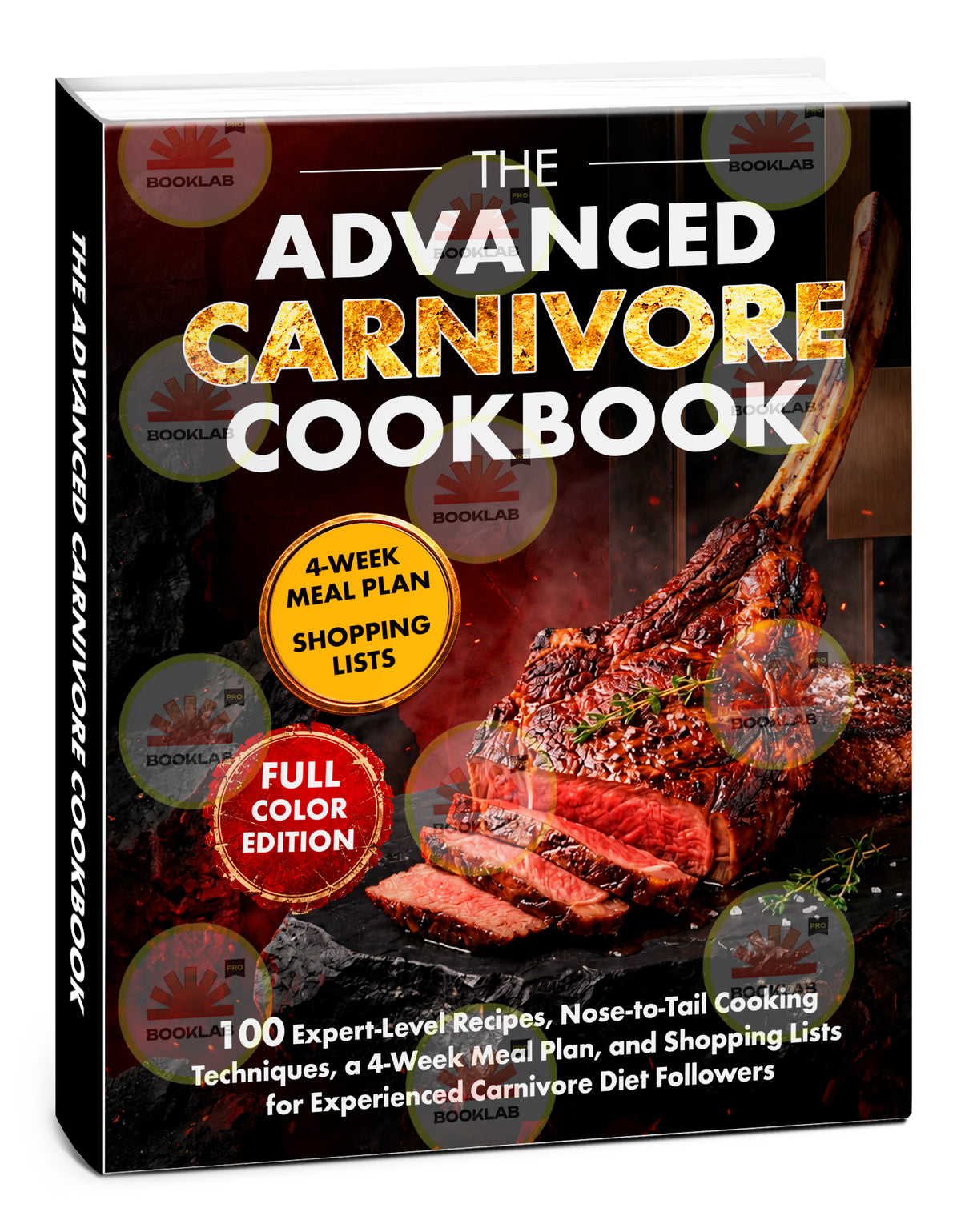
The Advanced Carnivore Cookbook
The Advanced Carnivore Cookbook
SKU:17369402
- Ready to publish on Amazon KDP
- Human-Written Manuscript
Couldn't load pickup availability
Premium Publishing Asset for Amazon Sellers: The Advanced Carnivore Cookbook
A professionally structured, 83-page cookbook manuscript featuring 100 advanced animal-based recipes, specialized meat-cooking techniques, nose-to-tail preparations, a 4-week meal plan, and weekly shopping lists — ready for publishing preparation.
This asset is designed for Amazon sellers who want to expand their KDP catalog within the carnivore diet, meat-focused cooking, and specialized cookbook niches without spending weeks developing complex recipes, researching traditional preparation methods, and organizing planning resources.
Created specifically for experienced carnivore diet followers, this cookbook goes beyond beginner-level meals to explore advanced culinary techniques, premium cuts, organ meats, homemade animal fats, and traditional preservation methods.
Combining detailed cooking instructions, practical sourcing knowledge, and structured meal planning, the manuscript provides a strong foundation for a specialized cookbook aimed at readers who want to advance their animal-based cooking skills.
⭐️ What’s Included:
✔️ Complete 83-page manuscript featuring 100 advanced carnivore recipes
✔️ Recipes organized into 11 specialized categories: beef, pork, lamb, goat, poultry, seafood, organ meats, eggs, dairy, broths, and preserved foods
✔️ Advanced techniques including reverse searing, sous vide, dry-aging, smoking, braising, and open-fire grilling
✔️ A dedicated nose-to-tail cooking section featuring liver, heart, kidney, tongue, sweetbreads, and other specialty cuts
✔️ Guidance on selecting premium meats, understanding cuts, working with butchers, and buying in bulk
✔️ Instructions for preparing beef tallow, lard, duck fat, bone marrow butter, and animal-based broths
✔️ Traditional curing and preservation recipes, including bresaola, guanciale, duck prosciutto, beef jerky, and smoked salmon
✔️ A structured 4-week meal plan with two meals per day for two people
✔️ Weekly shopping lists organized by ingredient category
✔️ Recipes with ingredient quantities, preparation times, cooking times, and estimated nutritional information
✔️ Practical guidance on kitchen equipment, meat storage, temperature control, and ingredient preparation
✔️ Suitable for Kindle and paperback publishing preparation
📈 Why This Is a Valuable Publishing Asset
You’re getting a complete, professionally structured cookbook manuscript — not a basic recipe collection or simple outline.
This asset targets a specialized segment of the carnivore cookbook market: experienced readers who want to explore demanding preparation methods and a broader variety of animal foods.
Unlike introductory carnivore cookbooks focused mainly on steaks, ground beef, and eggs, this manuscript covers dry-aged ribeye, slow-smoked brisket, premium cuts, organ meats, homemade broths, rendered fats, and traditionally cured meats.
The combination of 100 recipes, advanced culinary guidance, and a progressive 4-week meal plan provides several complementary content elements within one publishing asset.
💼 Ideal For:
- Amazon KDP publishers expanding their carnivore cookbook catalogs
- Sellers targeting experienced carnivore followers
- Publishing agencies seeking a specialized, fully written manuscript
- Entrepreneurs developing digital or paperback cookbooks
- Publishers interested in advanced meat preparation and nose-to-tail cuisine
- Sellers seeking a cookbook with recipes, educational content, meal plans, and shopping lists
🚀 What Makes This Book Special:
- 100 expert-level recipes across 11 specialized categories
- Developed for readers with previous carnivore cooking experience
- Technically demanding preparations beyond everyday meat dishes
- Traditional methods inspired by French, Italian, Argentine, and other culinary traditions
- Premium cuts alongside organ meats and less commonly used animal parts
- Specialized techniques including dry-aging, smoking, curing, and fat rendering
- Practical information about meat sourcing, storage, equipment, and temperature control
- Progressive 4-week meal plan with weekly shopping lists
- Detailed instructions and estimated nutritional values
- Focus on culinary knowledge without medical claims or unrealistic health promises
- Recipes, education, and meal-planning resources combined in one manuscript
The Advanced Carnivore Cookbook is a complete publishing asset for sellers entering the specialized animal-based cooking niche. With 100 expert-level recipes, detailed nose-to-tail guidance, traditional preparation techniques, and a complete 4-week meal plan, this 83-page manuscript provides a strong foundation for an Amazon KDP cookbook aimed at experienced carnivore diet followers.
- Number of pages: 83
- Trim Size Paperback: 8,5*11
- Trim Size Hardcover: 8,25*11
Share
What's Included
-
Manuscript PDF
Complete manuscript in PDF format
-
eBook Format
Ready-to-publish electronic book format
-
Plagiarism Report
Detailed plagiarism check report
-
Book Cover
Covers that sell and visuals that grab attention
-
Book Description
Book description for marketing purposes
-
Book Quality Guide
Guide to reviewing book quality before publishing on Amazon KDP
Book Details
Human-Written Content
This manuscript was written by human authors and reviewed by editors. We do not use AI-generated text for the core book content. Each title is created as an original publishing asset for Amazon KDP sellers who want ready-to-use, professional-quality content.
Outline Overview
Table of Contents
Introduction: Beyond the Basics
- Understanding what “advanced” carnivore cooking actually means
- Building a deeper understanding of animal-based ingredients
- The principles behind advanced preparation and cooking
- Setting up an efficient carnivore kitchen
- Choosing quality meat, seafood, organs, eggs, and dairy
- Understanding food safety, sourcing, and proper preparation
- How to use the recipes and the 4-week meal plan
Part 1: Foundations of Advanced Carnivore Cooking
- What separates advanced carnivore cooking from basic meat preparation
- Essential kitchen equipment, cookware, and tools
- Sourcing premium cuts, organ meats, seafood, and specialty ingredients
- Selecting and working with different cuts of beef, pork, lamb, poultry, and fish
- Mastering dry-aging, curing, smoking, searing, roasting, braising, and slow cooking
- Working confidently with rendered fats, bone marrow, and bone broths
Part 2: Beef — Steaks, Prime Cuts & Slow-Cooked Meats
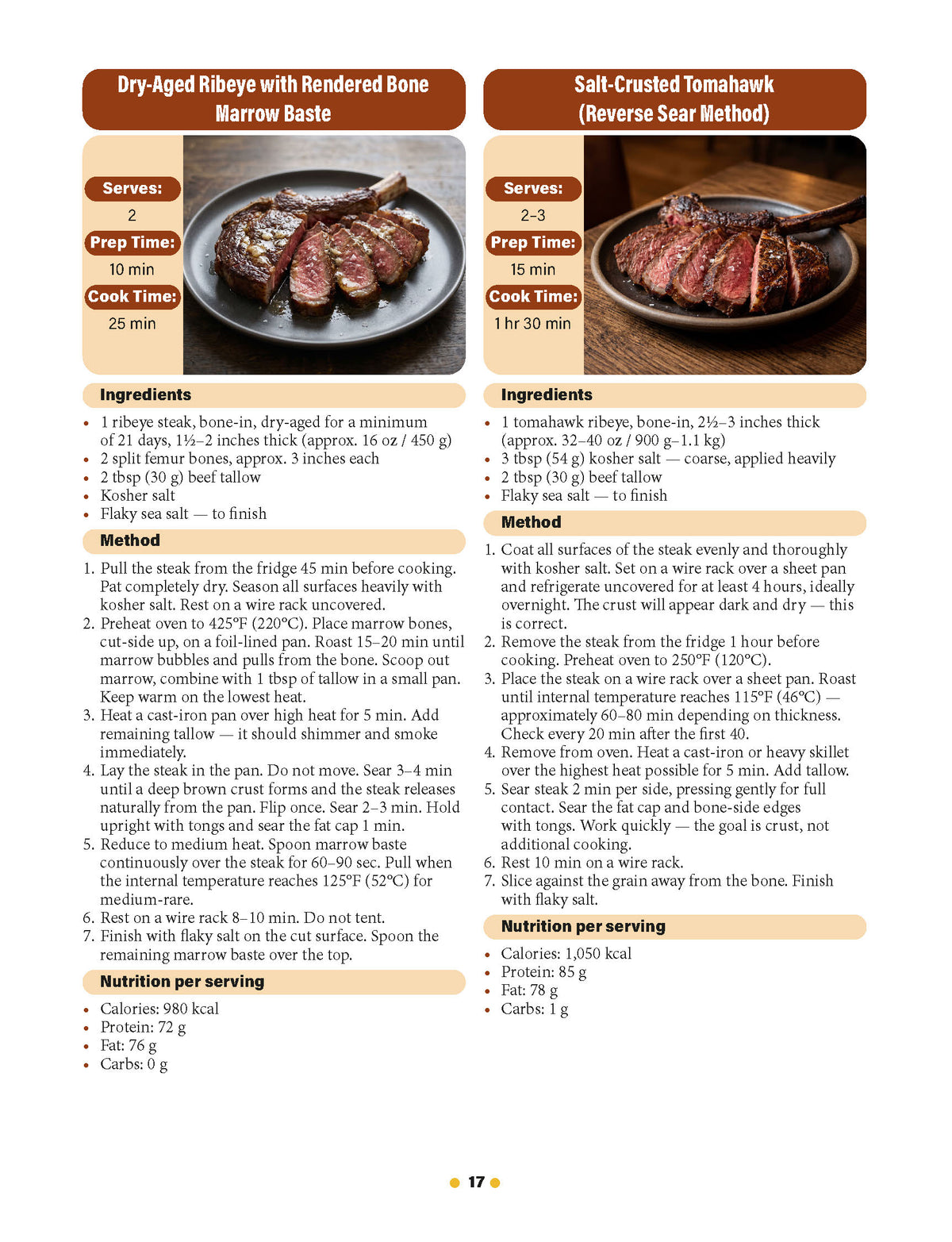
- Dry-aged steaks, tomahawk, ribeye, Wagyu, strip, picanha, and other premium cuts
- Reverse searing, open-fire cooking, smoking, salt curing, and tallow frying
- Working with tougher cuts through sous vide, braising, confit, and long smoking
- Short ribs, oxtail, cheeks, chuck, brisket, shank, neck, and blade roast
- Preparing beef tongue and other less common cuts
- Ground and formed beef including burgers, meatballs, kefta, meatloaf, and tartare
- Raw and lightly cured beef preparations
Part 3: Organ Meats & Nose-to-Tail Cooking
- Preparing liver, heart, kidney, lung, spleen, brain, and sweetbreads
- Working with beef, calf, lamb, chicken, and pork organs
- Pan-searing, braising, grilling, frying, and slow cooking organ meats
- Combining different cuts and organs into complete dishes
- Making pâté, mousse, hashes, and other nose-to-tail preparations
- Developing confidence with less familiar animal parts
Part 4: Pork, Lamb, Goat & Poultry
- Slow-roasted pork belly, shoulder, ribs, loin, and tenderloin
- Working with cured pork, guanciale, sausage, crackling, and fatback
- Salt-crusting, grilling, smoking, braising, and open-fire cooking lamb and goat
- Preparing lamb shoulder, neck, ribs, chops, and sausage
- Whole-animal poultry techniques for duck, chicken, goose, turkey, pigeon, and quail
- Confit, dry-brining, smoking, roasting, and rendered-fat cooking
Part 5: Fish, Seafood, Eggs & Dairy
- Whole fish preparation and salt-baking
- Confit, searing, poaching, smoking, and grilling fish
- Working with salmon, tuna, mackerel, sardines, branzino, and other seafood
- Preparing lobster, scallops, and oysters using multiple techniques
- Advanced egg preparations including cured yolks, custards, and deviled eggs
- Using bone marrow, butter, aged cheese, kefir, and other animal-based dairy ingredients
Part 6: Bone Broths, Rendered Fats & Advanced Preservation
- Building rich beef, lamb, pork, and chicken bone broths
- Maximizing collagen and gelatin extraction
- Rendering beef tallow, lard, duck fat, and other animal fats
- Clarifying, storing, and reusing rendered fats
- Making marrow butter and other concentrated fat preparations
- Dry-curing beef, pork, duck, and other meats
- Preparing bresaola, coppa, lardo, duck prosciutto, jerky, and pemmican
- Understanding curing, drying, smoking, storage, and food-safety principles
Part 7: The 4-Week Meal Plan
- Week 1: Premium cuts, steaks, and foundational techniques
- Week 2: Slow cuts, braises, organ meats, and nose-to-tail cooking
- Week 3: Pork, lamb, poultry, fish, seafood, eggs, and dairy
- Week 4: Broths, rendered fats, cured meats, and advanced preparations
Weekly Shopping Lists
- Beef steaks, roasts, ground beef, and specialty cuts
- Organ meats and less common animal parts
- Pork, lamb, goat, poultry, fish, and seafood
- Eggs, butter, cheese, kefir, and other animal-based dairy
- Bones, marrow, animal fats, and ingredients for stocks
- Ingredients and supplies needed for curing, smoking, and preservation
Conclusion: Mastering the Carnivore Kitchen
- Moving from basic meat preparation to advanced cooking techniques
- Building confidence with premium cuts and unfamiliar animal parts
- Understanding the role of fat, bone, marrow, organs, and connective tissue
- Developing skill through technique rather than complicated ingredients
- Creating a sustainable and varied approach to advanced carnivore cooking
Sample Chapter
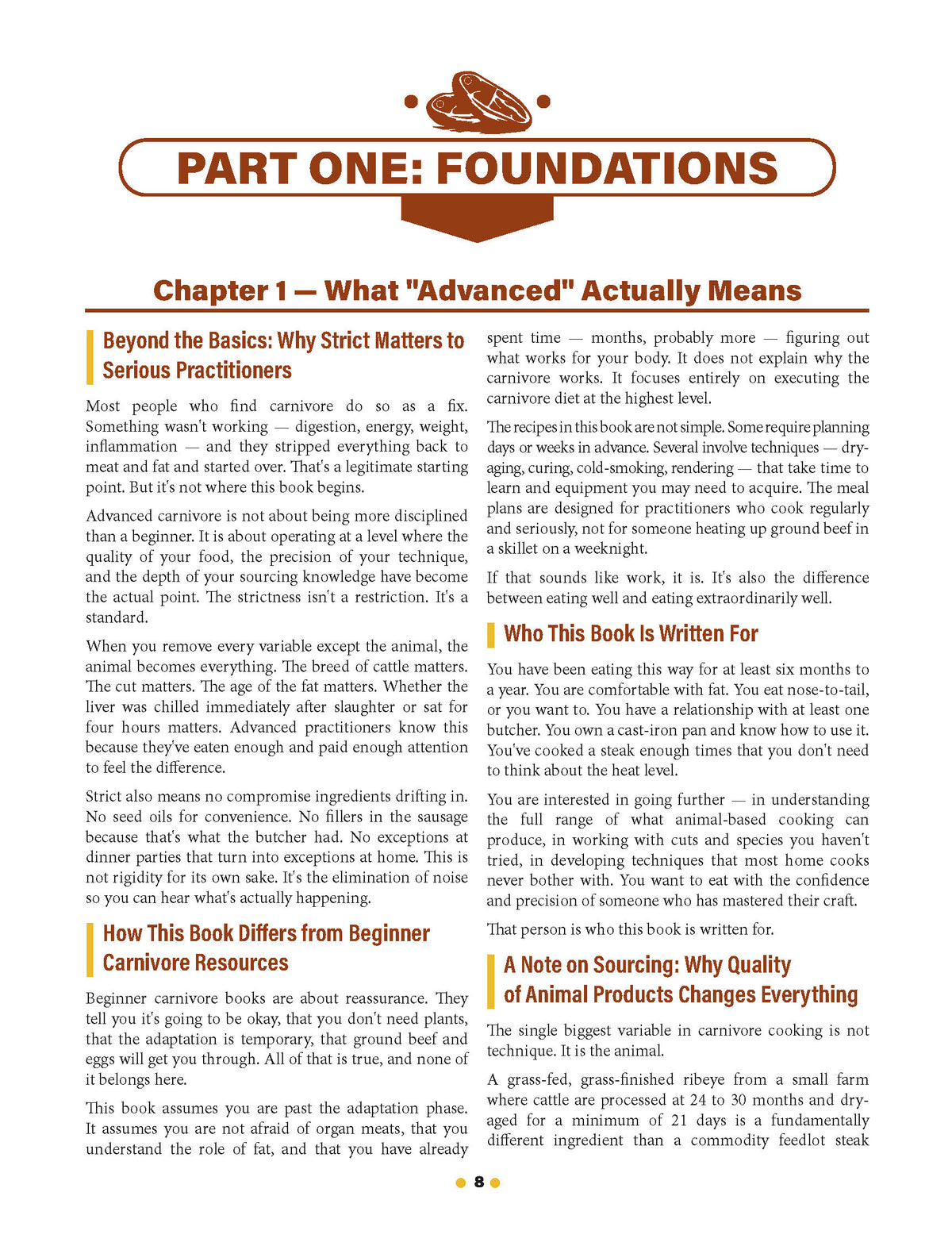
Chapter 1 — What "Advanced" Actually Means
Beyond the Basics: Why Strict Matters to Serious Practitioners
Most people who find carnivore do so as a fix. Something wasn't working — digestion, energy, weight, inflammation — and they stripped everything back to meat and fat and started over. That's a legitimate starting point. But it's not where this book begins.
Advanced carnivore is not about being more disciplined than a beginner. It is about operating at a level where the quality of your food, the precision of your technique, and the depth of your sourcing knowledge have become the actual point. The strictness isn't a restriction. It's a standard.
When you remove every variable except the animal, the animal becomes everything. The breed of cattle matters. The cut matters. The age of the fat matters. Whether the liver was chilled immediately after slaughter or sat for four hours matters. Advanced practitioners know this because they've eaten enough and paid enough attention to feel the difference.
Strict also means no compromise ingredients drifting in. No seed oils for convenience. No fillers in the sausage because that's what the butcher had. No exceptions at dinner parties that turn into exceptions at home. This is not rigidity for its own sake. It's the elimination of noise so you can hear what's actually happening.
How This Book Differs from Beginner Carnivore Resources
Beginner carnivore books are about reassurance. They tell you it's going to be okay, that you don't need plants, that the adaptation is temporary, that ground beef and eggs will get you through. All of that is true, and none of it belongs here.
This book assumes you are past the adaptation phase. It assumes you are not afraid of organ meats, that you understand the role of fat, and that you have already spent time — months, probably more — figuring out what works for your body. It does not explain why the carnivore works. It focuses entirely on executing the carnivore diet at the highest level.
The recipes in this book are not simple. Some require planning days or weeks in advance. Several involve techniques — dry-aging, curing, cold-smoking, rendering — that take time to learn and equipment you may need to acquire. The meal plans are designed for practitioners who cook regularly and seriously, not for someone heating up ground beef in a skillet on a weeknight.
If that sounds like work, it is. It's also the difference between eating well and eating extraordinarily well.
Who This Book Is Written For
You have been eating this way for at least six months to a year. You are comfortable with fat. You eat nose-to-tail, or you want to. You have a relationship with at least one butcher. You own a cast-iron pan and know how to use it. You've cooked a steak enough times that you don't need to think about the heat level.
You are interested in going further — in understanding the full range of what animal-based cooking can produce, in working with cuts and species you haven't tried, in developing techniques that most home cooks never bother with. You want to eat with the confidence and precision of someone who has mastered their craft.
That person is who this book is written for.
A Note on Sourcing: Why Quality of Animal Products Changes Everything
The single biggest variable in carnivore cooking is not technique. It is the animal.
A grass-fed, grass-finished ribeye from a small farm where cattle are processed at 24 to 30 months and dry-aged for a minimum of 21 days is a fundamentally different ingredient than a commodity feedlot steak shrink-wrapped in a supermarket case. Both are beef. The similarity more or less ends there.
This is not snobbery. It is biochemistry. The fat profile, the depth of flavor, the texture after cooking, the color of the fat, the smell of the raw meat — all of these differ substantially based on what the animal ate, how it lived, and how it was handled after slaughter. Advanced practitioners learn to identify quality before it hits the pan, not after.
Chapter Three covers sourcing in full. For now, understand this: every technique in this book will produce better results with better ingredients. The investment in sourcing is not separate from the investment in cooking. It is the foundation of it.
Chapter 2 — The Carnivore Kitchen
Essential Tools and Equipment
You do not need much. But what you need, you need to have right.
Cast-iron skillet — the single most important piece of equipment in a carnivore kitchen. A well-seasoned 12-inch skillet handles steaks, livers, sausages, rendered fat, and eggs with equal authority. Buy one quality pan and use it for everything. Lodge is the standard entry point; Stargazer and Finex are worth the upgrade if you cook daily.
Heavy carbon steel pan — for high-heat searing, where cast iron is too slow to heat evenly. Carbon steel reaches temperature faster and is easier to maneuver. Essential for duck breast, fish, and thin cuts that need instant, controlled heat.
Dutch oven (5–7 quart, enameled cast iron) — for braises, stocks, and slow cooking. Le Creuset and Staub are the benchmarks. A good Dutch oven is a 30-year investment.
Instant-read thermometer — a Thermapen or equivalent. Non-negotiable. The difference between medium-rare and medium is 5°F, and guessing costs you the steak.
Probe thermometer — for long cooks, smokes, and reverse sears where you need continuous temperature monitoring without opening the oven or smoker.
Boning knife — a 6-inch flexible boning knife for breaking down whole animals, seaming out muscles, and trimming. Victorinox makes an excellent one at a reasonable price.
Chef's knife — for everything else. A well-maintained 8 or 10-inch chef's knife does 90% of the cutting work in this kitchen.
Wire rack over sheet pan — for resting meat, reverse searing in the oven, and drying surfaces before a hard sear. Moisture is the enemy of crust. Elevate everything.
Large stockpot (12+ quart) — for bone broth. You need volume to do this properly.
Smoker — optional but transformative. An offset stick burner produces results that no other cooking method replicates. If a full smoker is impractical, a kettle grill with indirect setup and wood chips will handle most recipes in this book.
Sous vide circulator — for precision cooking of tough cuts and long braises. Not essential, but the 72-hour short rib is worth the investment alone.
Kitchen scale — for curing ratios. Curing by weight is not optional. It’s a matter of safety.
Rendering Your Own Fats: Tallow, Lard, Duck Fat, Bone Marrow Butter
Rendered animal fats are the cooking medium, the finishing element, and in some cases the recipe itself. Buying pre-rendered fat is acceptable. Rendering your own is better in every dimension — flavor, freshness, cost, and control over the source.
Beef Tallow is rendered from suet, the hard fat surrounding the kidneys. It has a high smoke point (around 400°F), a clean, neutral beef flavor, and sets firm at room temperature. It is the primary cooking fat for high-heat searing and frying in this book. Wet rendering (simmering suet in water, then separating) produces a cleaner, more neutral tallow. Dry rendering (low oven heat, no water) produces a more intensely flavored result. Both are correct. Both are used here.
Lard is rendered from pork fat — ideally, leaf lard from around the kidneys, which is softer and more neutral than back fat. Lard has a slightly lower smoke point than tallow but a more delicate flavor. It is the fat of choice for pork preparations and certain egg dishes.
Duck Fat is rendered from the thick layer of fat beneath a duck's skin, typically from the legs and back. It is silkier than tallow and lard, with a distinctive savory depth that makes it worth using specifically — not as a substitute for tallow, but as its own ingredient. Confit requires it. Potato alternatives do not apply here, but the fat is excellent for poultry of all kinds.
Bone Marrow Butter is not rendered in the traditional sense — it is roasted out of split femur bones and then whipped, often with salt and sometimes with a small amount of cultured butter, into a compound. It is rich, intensely beefy, and extraordinary as a finishing element over hot steaks or applied to grilled meat directly off the fire.
To render tallow or lard at home: cut the fat into small pieces, add to a heavy pot with a small amount of water to prevent scorching, and heat over low to medium-low heat for one to two hours, stirring occasionally, until all fat has liquefied and the remaining solids (cracklings) are golden and beginning to separate. Strain through a fine mesh strainer or cheesecloth. Cool to room temperature, then refrigerate or freeze.
Dry-Aging at Home: Techniques for Beef, Lamb, Pork
Dry-aging is controlled decomposition. Enzymes naturally present in the meat break down muscle fibers, tenderizing the texture while evaporation concentrates the flavor. A properly dry-aged steak has a depth of nuttiness and savory intensity that no fresh-cut beef can match.
Commercial dry-aging happens in walk-in coolers with precisely controlled temperature, humidity, and airflow. Home dry-aging is simpler and more accessible than most people assume.
Temperature: 34–38°F. Your refrigerator's coldest setting, or a dedicated mini-fridge set for the purpose. Consistency matters more than precision within this range.
Humidity: 75–85% relative humidity. Lower, and the crust dries too fast, sealing in moisture that should evaporate. Higher, and you risk mold growth that penetrates rather than stays on the surface.
Airflow: Place the meat on a wire rack, never directly on a tray. Air needs to circulate on all sides. A small fan inside a dedicated fridge is useful for longer ages.
Time: 21 days produces noticeable tenderness and flavor development. 28–35 days is the sweet spot for most home applications — meaningfully different from fresh, manageable in terms of trim loss. Beyond 45 days is for experienced practitioners who understand the increasingly aggressive flavor profile and are comfortable managing the process.
Trim: The exterior of a dry-aged cut develops a dark, hard crust called the pellicle. This is trimmed away before cooking. Expect 15–25% weight loss on longer ages. This trim loss is factored into the cost, which is why properly dry-aged beef costs what it does.
Beef and lamb dry-age exceptionally well. Pork is more nuanced — short aging (7–14 days) on pork chops or belly improves texture significantly, but longer aging requires a more controlled environment than most home setups can provide.
See Inside the Book


